

Table of Contents
WP Engine: A Quick Overview
Whoishostingthis.com’s Editor Rating?
WP Engine Reviews: What Users Say?
WP Engine Pros and Cons
WhoIsHostingThis.com’s Editorial Review
Who Should Choose WP Engine?
WP Engine Plans and Pricing
Features
Performance and Uptime
Security
Support
Recent Improvements
Compare WP Engine Alternatives
What You Need to Know
What Is WP Engine the Company?
How We Reviewed WP Engine
| WP Engine standout features | |
| Performance | Superb, consistent real-world performance |
| Average load time | 1950ms |
| Average response time | .152 Seconds |
| Free domain | No |
| Secure Sockets Layer (SSL) | Yes |
| 1-click WordPress | Yes |
| Support | 24/7 live chat, phone, and email support |
WP Engine Pros and Cons
Many users like WP Engine because of its excellent performance, reliable customer support, and focus on security. However, there are some drawbacks with WP Engine such as being expensive. I asked a WP Engine power user to comment on his experiences with the web host and he had this to say:
What we like about WP Engine
- 60-day money back guarantee: The company offers a 60-day money-back guarantee and employs a dedicated team to monitor its security 24/7.
- Consistent and reliable performance: WP Engine offers 99.95% server uptime, which equates to only four to five hours of annual downtime.
- Excellent loading speeds: The hosting services offer superb loading speeds and its Cloudflare Content Delivery Network (CDN), solid state drive (SSD), and NGINX technology ensure snappy web pages.
- Award-winning customer support: A great team provides 24/7 support via live chat, phone, and email.
- Effective staging environment: The staging environment allows you to create duplicate versions of your site and test new themes, plugins, and other features.
What fell flat
- Exclusive to WordPress: WP Engine only offers its web hosting services to WordPress.
- No email hosting: The company does not provide its own email hosting service. You’ll have to use third-party services.
- No domain hosting: WP Engine does not sell domain names.
- Disallowed plugins: The platform claims that certain plugins negatively impact performance and security.
- Premium pricing: It is by no means an affordable web hosting service; however, it offers the best hosting for your WordPress site.
WhoIsHostingThis.com’s Editorial Review
WP Engine offers exceptional uptime, security updates, cloud platform flexibility, one-click restore points, automatic caching, daily backups, and other premium features. It’s an outstanding option for WordPress hosting.
Staging sites
Many website hosting companies offer site staging with their more expensive plans, while WP Engine allows this with all of their plans.
Site staging lets you create a duplicate version of your website where you can make changes to the layout, try new themes and plugins, and identify any errors before your site goes live.
However, WP Engine does not allow you to upload a non-WordPress website from Windows or Linux —it’s strictly a WordPress-based hosting service. You get WordPress pre-installed, so you don’t have to worry about installing additional plugins.
Free automated migrations
WP Engine offers you a free plugin that allows you to perform automated migrations for your WordPress site. This means you can migrate your WordPress website to the WP Engine without a hitch.
The plugin will do the work for you, so you can focus on other aspects of your website. WP Engine’s automated migration tool is a quick and easy way to migrate multiple WordPress websites.
Unlimited development sites
WP Engine refers to a “site” as a group of three environments:
- Production
- Staging
- Development
These three environments offer full customizability to make your development workflow easier. You can also push or pull staging sites to or from your live site separately and safely.
Independent environments
We’ve already covered staging sites as a way to resolve errors or make changes to your website. Another option that WP Engine offers is to use independent development environments to create and test new sites.
Once you’re done, simply copy your changes to your live site. Since they work independently, the changes you make to one environment won’t affect the others.
Local development
Local is a powerful WordPress development tool that you can use to set up staging sites on your local device. It’s available for free with all WP Engine hosting plans.
The tool allows you to test your site through local staging environments — offline or online. What makes Local special is that it allows you to upload your new changes with one click, so you don’t have to go through any manual WordPress installation setups. You even get an SSL free.
Premium themes and block tools
Every WP Engine hosting plan comes with 10 themes that the Genesis Framework powers. All premium themes are optimized for performance and SEO, making your design and editing process more efficient.
10 premium StudioPress themes with Genesis Framework
You get 10 Premium StudioPress themes with WP Engine, no matter which plan you choose. All themes are Genesis-backed, which means you’ll need to install the Genesis Framework if you want to use any of the free themes.
You can find the full list of available themes here. WP Engine constantly updates its list, so make sure you check in regularly to see if there are any new themes.
Advanced security features
WP Engine’s security detects and blocks 26 billion cyberattacks every year. The team constantly monitors your site to ensure it is safe. You also get automated WordPress plugin and PHP updates, along with multi-factor password authentication.
But that’s not all. WP Engine will include an enterprise-grade add-on called Global Edge Security. Available on all plans, this feature offers a Web Application Firewall (WAF) optimized for WordPress, advanced Distributed Denial of Service (DDOS) Mitigation, CDN, and SSL installation.
Daily backups
As part of your security, WP Engine will backup your WordPress site every day, which means you can go back and restore any previous versions of your website if you wish to. They also allow manual backups, so you can backup your site with a plugin. WP offers a number of free plugins, such as the UpdraftPlus WordPress Backup Plugin, which will keep all your data safe in case of an attack or a breach.
Uptime and reliability
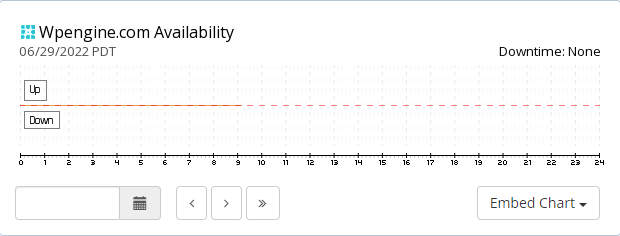
According to our tests, WP Engine servers have experienced zero downtime in the past 30 days, which is very impressive. This, combined with the fact that WP Engine offers a 99.95% uptime guarantee makes it clear it offers an exceptionally reliable hosting environment.
Site response times
One important aspect of a hosting company is how fast its servers respond to requests. This directly impacts how quickly your site loads for visitors. There are dozens of factors that influence the speed at which a hosting company’s servers respond. Finding a host that has consistently fast response times is important.
We found that WP Engine has a site loading time that is constantly under 2000ms, which is very good. This is made possible not just by its quality servers and backend configuration, but also by the fact that it offers a CDN to all its customers for added speed and reliability.
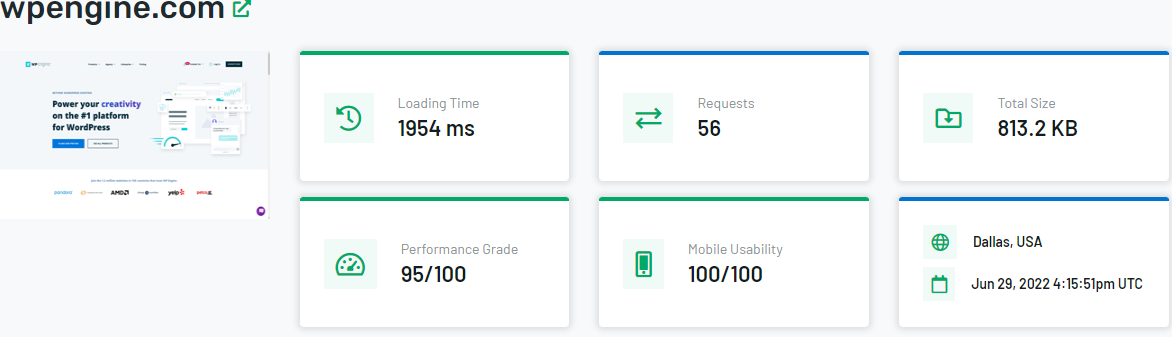
At the time of our testing, we found that WP Engine had a response time of 1954ms, which is quite good. Your results will vary based on where you test from, the time of day, congestion at your local ISP, and more. Of course, the site loading time will also depend on what you place on each of your pages.
Optimized WordPress tools
WP Engine offers a host of WordPress-optimized site-building tools for your convenience. These tools help with site migrations and transfers, staging environments, SSH access, GIT and SFTP connections, and page performance monitoring.
SSL certificates
All of WP Engine’s hosting plans come with a free SSL certificate. But what is an SSL certificate, and do you even need one?
SSL is a cryptographic encryption security protocol. In simple terms, an SSL is a series of communications or instructions sent over a computer network. For example, your server and web browser exchange information, and an SSL will ensure that this information is being transferred securely and not intercepted by external parties.
Protecting your data
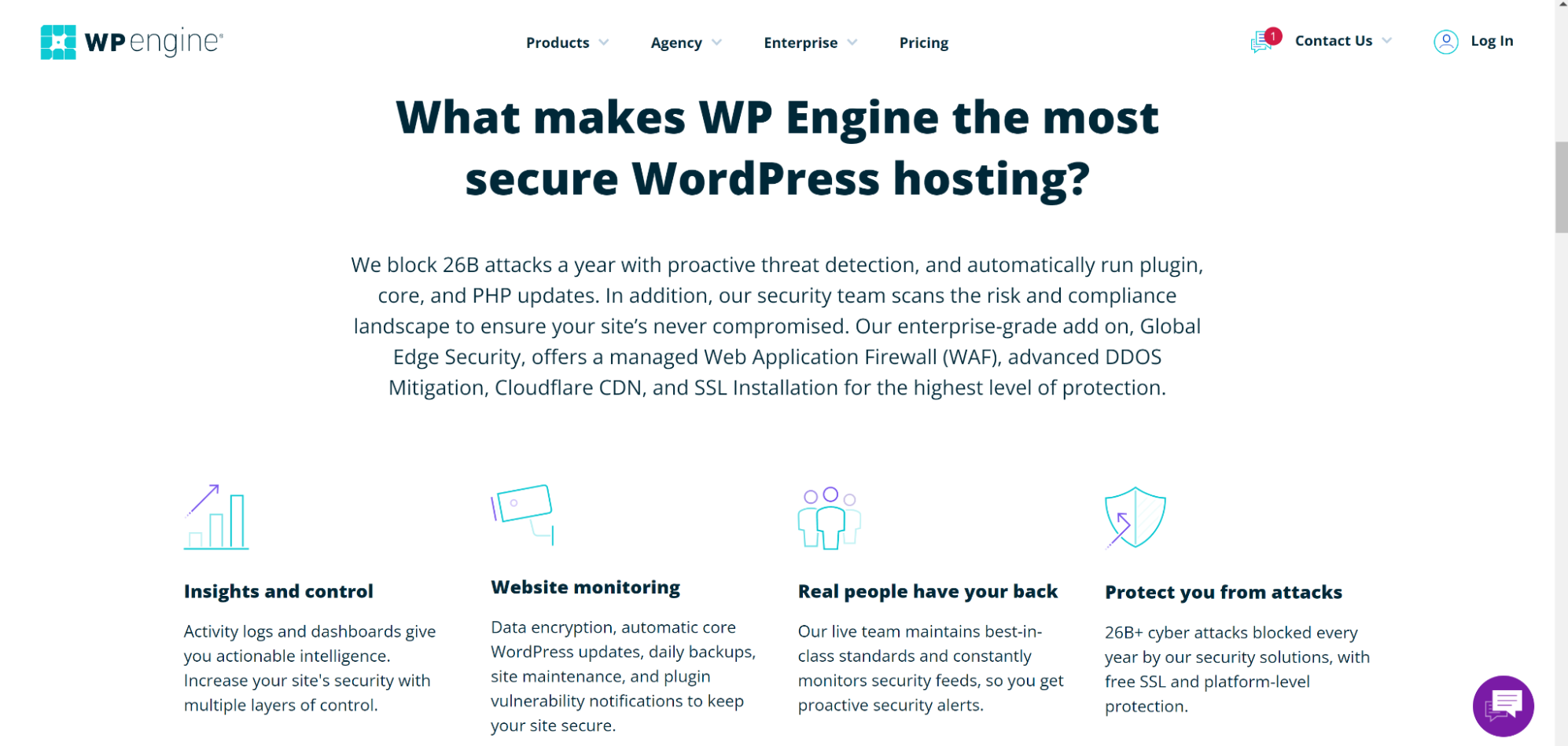
Available across all plans, WP Engine includes an enterprise-grade add-on called Global Edge Security, which uses multiple features to protect your WordPress website from over 72 million cyber attacks daily.
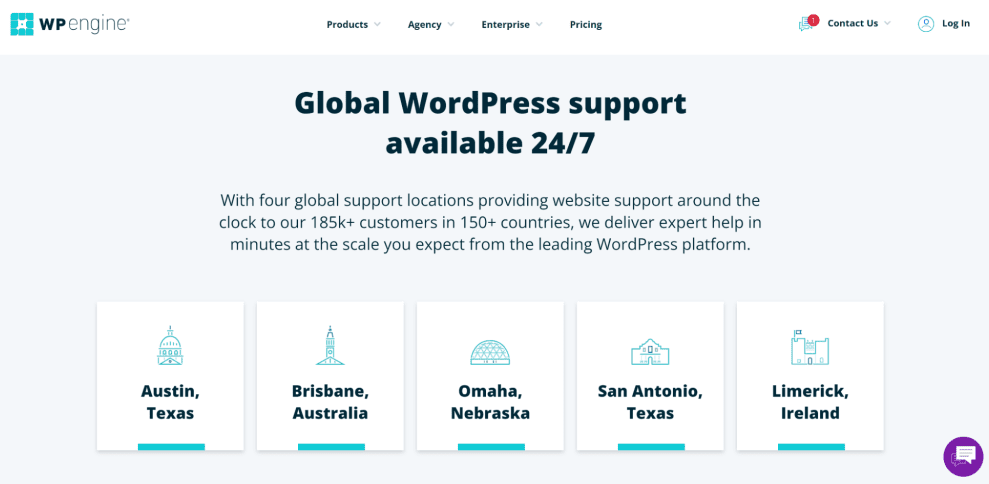
I was able to find answers to some of my questions in the user guides on the website. These guides are comprehensive and have answers to the most commonly asked questions.
WP Engine has also created a very useful support bot that sent me links to resolve a number of common problems. It also volunteered to help me speak to one of WP Engine’s human agents when I typed in “support.” Since these agents are available around the clock, it was very easy to get in touch with them even when I was working late at night.
Compare WP Engine Alternatives
With an estimated 330,000 web hosting providers worldwide, you have plenty of web hosts to choose from. However, it’s not the only managed WordPress hosting provider–see all of our top picks to learn more about your options.
On top of that, WP Engine is overkill for brand new websites and most businesses, overall.
If you’re looking for something more suited to new sites and beginners at a more affordable price point, see how WP Engine compares to cheaper alternatives below.
What You Need to Know
Why should I use WP Engine?
Is WP Engine different from WordPress?
Does WP Engine have phone support?
Can I host a Non-WordPress site on WP Engine?
Can you register domain names with WP Engine?
Can I manage multiple WordPress sites on one WP Engine account?
How many data centers does WP Engine have?
Will I get automated migration with my WP Engine plan?
How will WP Engine keep my WordPress site protected?
Do I get an SSL certificate with my WP Engine plan?
How We Reviewed WP Engine
I test web hosts based on the following factors:
Learn more about our review methodology.